
AGSG Health Foundation: Empowering Health for All


Art & Technique of breast feeding
Breast feeding is natural & most mothers will take to it without any problems. However, some mothers & babies need help. In due course of time, with practice, breastfeeding is achieved effortlessly. There are certain steps that will help you breastfeed with ease. It may take time, sometimes days, but perseverance pays rich dividends.
Mother’s position
Step 1
Find a comfortable position for yourself .You may lie down, sit on a chair, on the bed to feed your baby. Remember to support your back ALWAYS.
Step 2
Hold your baby in your arm so that the head & neck rests in the bend of your elbow, the back along your forearm & the buttocks in your hand.
Step 3
Turn the baby’s entire body towards your so that the baby’s tummy touches your tummy.
Step 4
Raise the baby to the level of your breast so that the baby’s mouth can easily reach the nipple & areola. Sometime, you may need to tuck the baby’s arm away so that it does not come in the way.
Step 5
When the nipple touches, the baby’s lips or cheek, your baby’s mouth will reflexly open to draw the nipple & part of areola to form a teat .To effectively suckle milk from breast, both nipple & areola should go into the baby’s mouth.
 The Cradle Hold
This is the first hold many mothers will try, often soon after their babies are born. To start, cradle your baby’s head in the crook of your arm with your baby’s nose opposite your nipple. Use that hand to support your baby’s bottom. Turn your baby on his or her side, so that your baby is belly to belly to you. Then, raise your baby to your breast. You can support your breast with your other hand.
The Cross-Cradle or Crossover Hold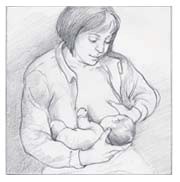
This hold is similar to the cradle hold, but your arms are positioned differently. Instead of supporting your baby’s head in the crook of your arm, use the hand of that arm to support your breast. Your opposite arm should come around the back of your baby. Support your baby’s head, neck, and shoulder by placing your hand at the base of your baby’s head with your thumb and index finger at your baby’s ear level. Like the cradle hold, your baby will be belly to belly to you.
The cross-cradle position allows you to have more control over how your baby latches on. Many moms find that they’re able to get their babies latched on more deeply with this hold.
The Side-Lying Position
This position is comfortable for mothers who’ve had a cesarean section (C-section) because the baby doesn’t put pressure on the mother’s abdomen. This is also a great way for you to get some rest while nursing your baby.
Start by lying on your side with your baby on his or her side, facing you. Your baby should be positioned so his or her nose is opposite your nipple. Use your lower arm to cradle your baby’s back, or you can tuck a rolled-up receiving blanket behind your baby to help nestle your little one close to you while you use your arm to support your own head. You can support your breast with your other hand.
The Clutch or Football Hold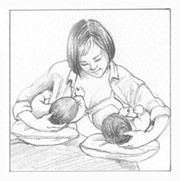
This is also a good position for the mom who’s had a C-section and also for mothers with large breasts or small babies. The football hold allows babies to take milk more easily — which is also good for mothers with a forceful milk ejection reflex (or let down).
To achieve the clutch (or football) hold, place a pillow next to you. Cradle your baby — facing upward — in your arm. Use the palm of your hand on that same arm to support his or her neck, and nestle your baby’s side closely against your side. Your baby’s feet and legs should be tucked under your arm. Then lift your baby to your breast.
SIGNS OF GOOD ATTACHEMENT
o Baby’s mouth is wide open
o Chin touches the breast
o Nipple & most of areola are inside the baby’s mouth
o Lower lip is turned outwards
o You feel no pain while breastfeeding
BURP
Different positions to burp a baby
1. Hold him with his chest and tummy against your shoulder and with one hand supporting his bottom while the other rhythmically pats his back. Place a burping cloth or towel on your shoulder. This is the best position for burping newborns.
2. Place him tummy down across your lap. Make sure that his head is supported. Also make sure you have a burp cloth under baby for encase he spits up.
3. Burp baby while he is sitting up on your leg leaning forward with your hand under his chin for support while the other hand pats him on the back.
FAQ’s
Whether you are a new mom or a seasoned pro, breastfeeding often comes with its fair share of questions. Here are some answers to common inquiries that mothers –new & veteran – may have.
How do I prepare for breastfeeding?
Breast feeding is your choice, but it should be fully informed. Everyone involved with the baby & mother need to be educated about & supportive of breastfeeding.
When should I begin breastfeeding?
If possible try to start feeding as soon as possible (within an hour of birth).
Even if your baby doesn’t correctly attach to your breast, starting early helps you & your little one to practice & get used to the idea of breast feeding.
It may take a few times before getting it right.
To help both you & your baby get used to breastfeeding, try to feed about every 3 hrs., even overnight.
When will my milk come in?
During the first few days after birth of your baby, your body will produce colostrum, a sort of premilk. Colostrum is thick & yellowish & contains many protective properties, including antibacterial & immune – boosting substances. The flow of colostrum is very slow.
After about 3-4 days of nursing, your breasts will start to feel softer & more firm as your milk changes from colostrums to that looks kind of like skim milk. Your milk will be transitional for the first 10-14 days, after which it is considered to be mature milk.
During this time, amount of milk your body produces will increase, responding to your baby’s nursing .Your milk supply is determined by the stimulation your body receives. So, the more you feed, the more milk your body produces.
Are bottles or pacifiers okay?
If you are committed to trying to exclusively breast feed, you don’t want your baby to suck on a pacifier or a bottle.
In the beginning, it’s important to allow to practice breastfeeding without being confused by a bottle or a pacifier.
What are the signs that my baby is hungry?
Despite what some new mothers might think, crying is a late sign of hunger.
You should try to nurse before your baby is so hungry that he or she gets really upset & becomes difficult to calm down.
Signs that baby is hungry include:
o Moving their heads from side to side
o Opening their mouths
o Placing their hands & fists to their mouths
o Puckering their lips as if to suck
o Nuzzling again their mother’s breasts
o Stretching
o Showing the rooting reflex(when a baby moves its mouth in the direction of something that’s stroking or touching its cheek)
How can I tell when I’m ready to breastfeed?
Most women can feel the milk ejection reflex (or let down) – when the milk starts coming into their breasts for a feeding. During the first few days to weeks after delivery, you may feel strong cramps in your uterus when your milk lets down.
You may also feel a sense of engorgement, like your breasts are filling up & becoming firm, or a sort of tingling sensation in your breasts. You may also feel or see milk leaking from your nipples. Some women, however, never have a feeling of let down, which is OK, too.
How can I tell if my baby is latched on correctly?
This is often the No. 1 reason that new mothers have a hard time with breastfeeding-their babies aren’t latched on to their breasts properly, which can be frustrating for the babies and downright painful for their mothers.
Here’s how you can make sure your little one is latched on correctly every time:
1. Make sure your baby’s mouth is opened wide and his or her tongue is down when latching on.
2. Support your breast with your hand, positioning your thumb on top and your fingers at the bottom, keeping your thumb and fingers back far enough so that your baby has enough of the nipple and areola (the circle of skin around the nipple) to latch onto.
3. Gently glide your nipple from the middle of your baby’s bottom lip down to his or her chin to help prompt your baby to open his or her mouth.
4. When your baby opens his or her mouth wide and the tongue comes down, quickly bring your baby to your breast (not your breast to your baby). Your baby should take as much of your areola into his or her mouth as possible.
5. Make sure your baby’s nose is almost touching your breast (not pressed against it), his or her lips are turned out (or flanged), and you see and hear your baby swallowing. (You should be able to tell by seeing movement along your baby’s lower jaw and even in your baby’s ear and temple.)
When properly latched on, you may have 30 to 60 seconds of latch-on pain (this is caused by the nipple and areola being pulled into your baby’s mouth) then the pain should subside. It will then feel like a tug when your baby is sucking. If you continue to feel pain, stop feeding momentarily and reposition your baby on your breast. If you still feel pain during feeds even after repositioning, talk to your doctor to make sure something else isn’t going on, such as an infection.
Your baby will often give four to five sucks, followed by a 5- to 10 second pause. Your baby’s sucks will increase in number as the quantity of your milk increases. As the milk flow slows, your baby’s pattern will probably change to three or four sucks and pauses that last longer than 10 seconds.
Most babies will release the breast on their own. If your baby doesn’t release your breast but the sucks now seem limited to the front of his or her mouth, you can slip your finger in the side of your baby’s mouth (between the gums) and then turn your finger a quarter turn to break the suction. Then, try to burp your baby and switch him or her to the other breast.
I’m having a hard time. What can I do?
This is completely normal. Whereas nursing may come easily for some women, it can take some adjustment and practice time for many others. Breastfeeding your baby may be one of the most challenging but rewarding things you’ll do as a mother.
While you’re in the hospital, don’t hesitate to use the expertise of the nursing staff and your pediatrician, gynecologist.
Whatever you do, try not to become too discouraged. With a little patience and some practice, it will likely become easier for both you and your baby in the coming weeks. Like the old saying goes, practice makes perfect!
How can I increase my milk supply?
Your milk supply is determined by the stimulation that your baby provides while nursing. In other words, the more you breastfeed, the more milk your body produces. So, if you seem to be producing less milk than usual, you should simply try to feed your baby more often.
Stress or illness can temporarily decrease your supply. Drinking lots of water and eating good, nutritious food can help. But also try to take some time for yourself each day, even if it’s only for 15 to 30 minutes.
If your baby is less than 6 months old and you’re away from your little one for long stretches during the day (for instance, at work), you may pump about every 3 hours to maintain your supply.
If your milk supply still seems low and you’re concerned, you may want to talk to your doctor, your pediatrician.
If I wait to nurse, will my milk supply increase?
Actually, no — it’s the opposite. Waiting too long to nurse or pump can slowly reduce your milk supply. The more you delay nursing or pumping, the less milk your body will produce because the overfilled breast sends the signal that you must need less milk.
However, that doesn’t mean that letting your baby sleep through the night (usually around 3 months old) is going to hurt your breastfeeding efforts. That just means that your body will cut back on the number of feedings, which is fine because your baby no longer needs to be fed all night long anyway. Cutting back on feedings during the day, though, can lead to a decreased milk supply over time.
I’m producing too much milk. What can I do?
Whereas some women may feel like they don’t have enough milk, others may feel like they’re making too much. Some mothers’ bodies just produce more milk than their babies need. Others overstimulate their breasts by pumping or expressing milk in between feedings. If expressing or pumping to relieve discomfort, stick to 20-30 seconds or less.
Sometimes, nursing on one breast only during a feeding helps to lesson your milk supply. Over time, you should notice your milk supply and “let-down” (the milk ejection reflex) become easier to handle.
Sometimes a woman’s let-down is really strong and causes the milk to shoot out into her baby’s mouth, causing choking. You can avoid this by gently breaking the suction when your milk starts to let down, letting it spray into a towel, and then latch your baby back onto your breast again once your milk flow has slowed.
Nursing your baby in a more upright position (head above the breast) also may decrease the force of the let-down.
My baby favors just one breast. Is this OK?
Some babies may prefer one breast — maybe your nipple or areola is larger on one side. But to keep up your milk supply in both breasts — and prevent painful engorgement in one — it’s important to alternate breasts and try to give each one the same amount of nursing time throughout the day.
The American Academy of Pediatrics (AAP) recommends offering both breasts during each feeding for as long as infant remains on the breast and alternating which breast you offer first for each feeding.
If your baby doesn’t take one breast at all during a feeding, just make sure to start the next feeding with that breast. As long your baby is doing well and you’re comfortable, that’s all that matters.
Is it normal to have cramps while nursing?
Yes. During the first few days to weeks after delivery, you may feel strong, menstrual-like cramps in your uterus when your milk lets down.
Breastfeeding helps shrink the uterus, so nursing moms may have less blood loss after childbirth.
Is it normal to feel pain during or after nursing?
If your baby is latched on properly, you may have 30 to 60 seconds of pain (from the nipple and areola being pulled into your baby’s mouth), then the pain should subside. But if you continue to feel pain, stop feeding momentarily and reposition your baby on your breast. If the pain persists, something else might be going on.
If your baby consistently latches on wrong, sucking on your nipple without getting much of your areola in the mouth, you’ll probably feel discomfort throughout each feeding. Some moms say it’s painful or feels like a pinch as their babies nurse. And you’ll probably have sore, cracked nipples in no time.
Could the pain be caused by a breast infection?
If your breasts are sore and you have flu-like symptoms, fever, chills, a hard or red area of the breast, or red streaks on your breast, you may have an infection in your milk ducts called mastitis. If you have any of these symptoms, ask your doctor.
You may also have a yeast (or thrush) infection of your breast.
It’s important that you inform your doctor if you have any of these symptoms:
• shooting or burning breast pain either during or after feedings
• pain deep within your breast
• strong pain in the breasts or nipples that doesn’t get better after properly latching on and positioning your baby
• nipples that are cracked, itchy, burning, or are pink, red, shiny, flaky, or have a rash with little blisters.
Babies with oral thrush may have cracked skin in the corners of the mouth, and whitish or yellowish patches on the lips, tongue, or inside the cheeks.
Women who have inverted nipples (that turn inward rather than protrude out) or flat nipples (that don’t become erect as they should when your baby is nursing) also may have trouble breastfeeding and may experience frequent nipple pain. If either is the case, talk to your doctor about ways to make nursing easier and reduce any pain.
How can I ease my breast or nipple pain?
When dealing with sore breasts or nipples, here are some pointers for avoiding general pain in the future as well as making yourself more comfortable while your breasts heal:
• Make sure your baby latches onto your breasts correctly every time.
• Ask your doctor to recommend a special over-the-counter breastfeeding lotion to put on your nipples in between feedings to reduce any dryness.
• At the end of a feeding, massage some breast milk on your nipples, and then allow them to air dry.
• Try to nurse first on the side that’s less sore.
• Gently break suction when removing your baby from your breast. (Slip your finger in the side of your baby’s mouth, between the gums, and then turn your finger a quarter turn to break the suction.)
• Put ice packs or cool compresses on engorged breasts after feedings.
• Gently massage the sore area before nursing.
• Get plenty of rest and fluids.
• Some mothers with cracked or sore nipples find that pumping for 2 to 3 days allows their nipples to heal.
Can I still breastfeed if I have a breast infection?
Yes, you can continue to nurse your baby while treating your breast infection. In fact, continuing to breastfeed can help clear up the infection.
Is it normal for my breasts to become engorged?
Usually, yes, especially during the first few days or weeks that you’re breastfeeding. When your milk first comes in, your breasts become engorged (swollen and hard), which can be painful for some women. This is called primary engorgement and lasts a few days.
But the longer you wait to breastfeed or pump — both initially and throughout your time nursing — the more uncomfortable and engorged your breasts may become.
Also, nursing frequently (approximately every 2 to 3 hours) and trying to empty your breasts can help with the initial discomfort of engorgement.
Is there need to feed my baby honey, glucose water or other milk in the first few days?
No. The baby does not require glucose water or honey.
My baby passes semi- solids stools frequently in one day. Does it mean she has diarrhea?
The color & frequency of a baby’s stools change with the age of baby. The first stool is dark – blackish green, sticky & is called me conium. The color of stools slowly changes to green & then to bright yellow & is soft & curdy in consistency. A normal healthy newborn can pass such stools 6-8 times a day or more frequently each time she has a feed. Some may pass stool once in 2-3 days. Both patterns of stool passage are normal.
Should I give my baby additional water especially in summer?
A breastfed baby is on a liquid diet of milk which is 89% water. First part of breast milk is mostly water & quenches the baby’s thirst. The later part of milk contains fat & satisfies the baby’s hunger. So, breastmilk satisfies both the thirst & hunger of the baby & the baby does not require additional water.
How do I know if my baby is getting enough milk?
The best way to know if your baby is getting enough milk is by checking the weight of the baby. Most babies lose some weight in their first few days, but regain it within a week or two.
• By the fourth or fifth day, babies gain an average of 28 Gms /day.
• By the end of 1st week, your baby should have at least 6 wet diapers & 2-6 bowel movements per 24 hrs.
• Most babies double their birth weight at 6 months & triple it at 1 yr.
What should my diet be when I am breastfeeding?
Eat well while breastfeeding. You should have a well balanced diet with sufficient proteins which could be in form of milk, eggs, pulses or meat. You should also have sufficient fruits & vegetables & drink plenty of water.
Should I continue breastfeeding if I am ill?
Most illnesses are not a contraindication for breastfeeding.
How long should I breastfeed my baby?
The recommendation (by Indian Academy of Pediatrics, American Academy of Pediatrics) are that babies be exclusively breastfed for about the first 6 months of life. This means that your baby does not require any additional food or fluids, unless medically indicated.
Babies should continue to breastfeed for a year & for as long as is mutually desired by the baby & mother.
When should I start feeding my baby solid foods?
Solid foods need to be introduced at around 6 months of age.
How should I feed my baby when I get back to work?
When you have to get back to work, express your milk & store it.
Start expressing your milk weeks before you return to work.
Storing breast milk
Proper storage of your milk is essential to your baby’s health & nutrition. Follow these guidelines:
• Store milk in sterilized plastic or glass bottles or covered containers. Don’t use ordinary plastic bags or formula bottles for storing milk.
• Immediate refrigeration is recommended – use sealed & chilled milk within 24-48 hrs. Discard any that has been refrigerated > 48 hrs.
• You can store breast milk (in the rear of a freezer that’s attached to your refrigerator) for appx 30 days. If you have deep freezer (0 F), you can store breast milk in it up to six months.
• Freshly expressed milk can be remain at room temperature for up to 4 hrs.
Thawing breast milk
• Place the bottle or bag of breast milk in a bowl of warm water or hold it under warm running water to bring it to room temperature.
• Never heat breast milk in the microwave. This causes hot spots that can burn your baby, & it may destroy important nutrients.
• Do not refreeze thawed milk.
SLEEP – Yours & Baby’s
Where should my breastfed baby sleep?
You can choose to keep your baby close & make nighttime feedings easier by letting your baby sleep in a crib, bassinet, or play yard in your room, right next to your bed. Keep the room dimly lit for nighttime feedings & also keep stimulation to a minimum.
You should never let your baby sleep on a soft surface or in the same room with people who smoke. Babies should always be put on their backs to sleep.
My baby falls asleep while nursing. What can I do?
Your baby may seem to be snoozing away, but might just actually be peacefully nursing. However if you do not feel suckling, your baby may, indeed be sleeping, especially after a good feeding.
Babies who tend to latch on incorrectly, though will frequently sleep at the breast. If this happens, break the suction & reposition the baby. You can break the suction by slipping your finger in the side of your baby’s mouth.
If your baby is still asleep while feeding, undress the baby, tickle the baby’s feet, burp your baby, or try changing diaper in between switching breasts.
When will my baby sleep through the night?
Newborns should be woken up every 3-4 hrs. until their weight gain is established, which typically happens within first couple of weeks. After that it’s OK if a baby sleeps for longer periods of time.
At 3 months, a baby averages a total of 5 hours of sleep during daytime naps & 10 hrs. at night, usually with an interruption or two.
Will it hurt my milk supply to let my baby sleep?
Letting your baby sleep through the night (usually around 3 months old) isn’t going to hurt your breastfeeding efforts. Your body readjusts your milk supply based on when you nurse & how much your baby needs.


