AGSG Health Foundation: Empowering Health for All




Report of Ear & Hearing Screening Camp, National Institute of Health & Family Welfare (NIHFW), Munirka, New Delhi
Date: 23rd – 24th September, 2025
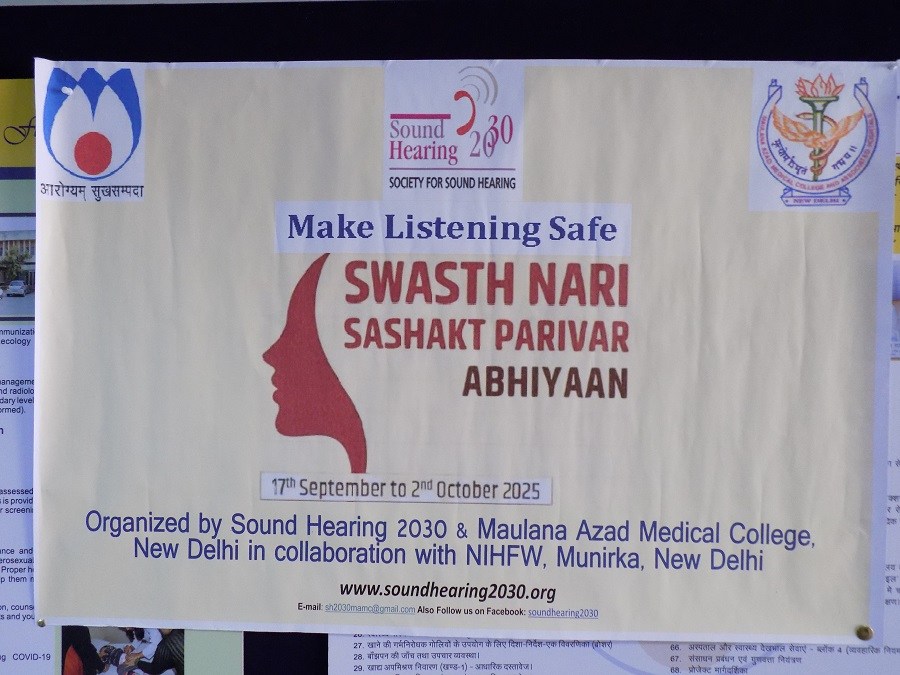
Organized by: Sound Hearing 2030, AGSG Health Foundation & Maulana Azad Medical College, New Delhi
In collaboration with: National Institute of Health & Family Welfare (NIHFW), Munirka, New Delhi
1. Introduction
A comprehensive Ear and Hearing Screening Camp was organized at NIHFW, Munirka, New Delhi, under the joint initiative of Sound Hearing 2030 and Maulana Azad Medical College. The primary objective was to promote ear and hearing health, provide preventive screening, identify common ENT problems, and ensure timely referral and management.
2. Participation
Total individuals screened: 185
Age group covered: 5–77 years (pediatric to geriatric population)
Screening conducted by: ENT specialists, Community Medicine doctors with support staff and audiologists
3. Gender Distribution
Out of 185 screened individuals, 67 were females and 118 were males.
4. ENT Examination Results
The Doctors Team of ENT, Community Medicine, MAMC, New Delhi, and NIHFW took patient histories, screened, and referred for hearing tests as required. Community Medicine doctors recorded findings and distributed medicines to screened individuals during the camp.
Findings from ENT Examination:
| S.No. | Diseases Found | Number of Cases |
|---|---|---|
| 1. | Ear itching / pruritus | 27 |
| 2. | Ear pain | 12 |
| 3. | Ear wax (including impacted/B/L) | 6 |
| 4. | Tinnitus (ringing in the ear) | 4 |
| 5. | Ear discharge (otorrhea) | 4 |
| 6. | Foreign body in ear | 1 |
| 7. | Vertigo | 1 |
| 8. | Hearing assessment requested | 17 |
| 9. | Normal | 114 |
Overall Outcome:
Normal findings: 114 cases
Abnormal findings: 71 cases
5. Audiometry (Hearing Assessment)
A total of 45 participants underwent audiometric evaluation to assess hearing levels. The testing helped in identifying early signs of hearing loss and the need for further management, including referral to specialized centers.
6. Age Group Distribution
The age group distribution highlights the participation of individuals across different age ranges. The data indicates a clear dominance of younger adults, particularly those in their twenties and thirties.
21–30 years: This age group has the highest representation with 70 individuals, reflecting the most active and engaged segment.
31–40 years: The second-largest group with 53 individuals, showing significant participation among early middle-aged adults.
41–50 years: With 31 individuals, this group also contributes notably, though less than the younger cohorts.
51–60 years: Participation decreases to 20 individuals, indicating reduced involvement in later middle age.
61–80 years: Only 2 individuals are represented, showing minimal participation among senior citizens.
5–10 years and 11–20 years: Younger age groups contribute 5 and 4 individuals, respectively, suggesting limited engagement among children and adolescents.

7. Hearing Test Results
A total of 45 persons underwent audiometry testing. The hearing assessment revealed a predominance of normal hearing, with only a small proportion diagnosed with varying degrees and types of hearing loss.
8. Key Observations
High prevalence of ear itching and ear pain, suggesting poor ear hygiene and possible environmental factors.
Presence of ear wax and otorrhea, indicating the need for awareness on self-care and timely medical consultation.
Hearing difficulties identified in a considerable number, underlining the importance of regular screening, especially in elderly participants.
Early detection of tinnitus and vertigo cases, which can be linked to lifestyle, occupational exposure, or underlying systemic issues.
Variety of impairments: Hearing loss cases were distributed across different severities and types, ranging from mild SNHL to profound hearing loss.
Early detection: The identification of mild and frequency-specific losses emphasizes the importance of screening for timely intervention.
9. Conclusion
The camp successfully screened 185 individuals across a wide age range, identifying both common and specific ENT concerns. With 71 cases showing abnormal findings, the activity highlighted the ongoing need for ear and hearing care initiatives in the community. The integration of ENT examination and audiometry allowed comprehensive assessment, ensuring early detection and timely management of hearing-related conditions.
The data reflects a reassuring picture, with most participants exhibiting normal hearing. However, the presence of different categories of hearing loss, though limited in number, underlines the need for awareness, preventive measures, and early intervention strategies to prevent progression and to support those affected.
10. Recommendations
Regular ENT and Hearing Camps – to be organized at institutional and community levels.
Awareness Campaigns – to educate people on ear hygiene, prevention of ear infections, and risks of self-cleaning.
Early Referral System – linking abnormal cases with higher referral centers for timely management.
Hearing Conservation Programs – particularly for elderly and high-risk occupational groups.
Integration with Primary Healthcare – training of frontline health workers to identify and refer suspected hearing cases early.